A Guide to Office Space in Atlanta, Georgia

A practical guide to renting office space in Atlanta, Georgia - covering the city's main business districts, key employers, workspace types, and how costs vary across the market.
Table of Contents
Atlanta attracts businesses for clear, practical reasons. It sits at the intersection of major transport routes, supports a dense mix of corporate headquarters and creative industries, and benefits from a steady pipeline of technical talent from nearby universities. The city’s international airport and highway network reinforce its role as a logistics hub, while its concentration of media, fintech, and corporate services creates deep supplier and client markets. Recent redevelopment, from Atlantic Station to the warehouse conversions in West Midtown, has also expanded the range of workspace options, from traditional offices to flexible formats like coworking spaces, giving businesses more choice in how they operate.
For businesses evaluating where to rent office space in Atlanta, this guide covers what you need to know about the office market.
Geographic and Economic Overview
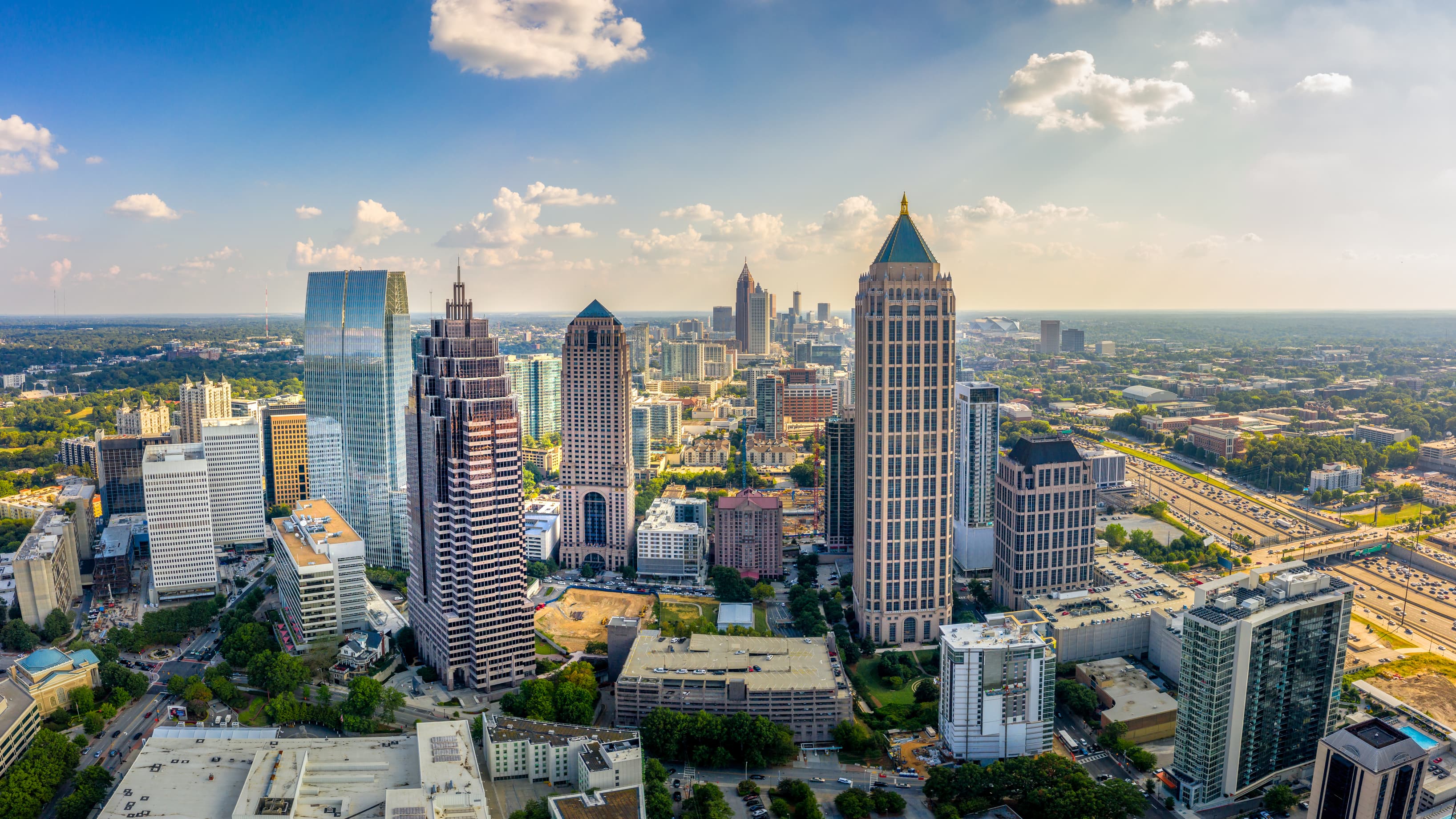
Atlanta isn't built around a single downtown core. It's a spread-out city with several distinct employment centres, each with its own character - which means there's real choice depending on what your business needs.
Hartsfield-Jackson is one of the world's busiest airports, and the interstate network ties central districts to suburban markets across the Southeast. The Atlanta BeltLine is gradually reshaping accessibility between neighbourhoods, and the city's mix of dense urban corridors, corporate clusters and repurposed industrial space in West Midtown reflects that variety.
Established headquarters in aviation, logistics, energy, and consumer brands sit alongside a growing technology and film sector. Georgia Tech and Emory feed steady technical and professional talent into the workforce - useful context when you're thinking about where to locate a team.
Top Business Areas in the City
Atlanta does not offer a single "central" office district in the way some older cities do. Instead, businesses choose among several distinct areas depending on sector, budget and access needs:
- Midtown: A tech and professional-services corridor anchored by Georgia Tech, with a strong supply of newer office towers, coworking options and direct MARTA rail access.
- Buckhead: The city's traditional high-end business district, with premium tower office space and corporate headquarters; attracts finance, law and executive-level functions.
- Downtown/ Centennial Olympic Park area: Government, convention, media and hospitality firms cluster here; proximity to the Georgia World Congress Center and Georgia State University is a feature.
- West Midtown: A former industrial area transformed into creative office campuses and loft-style workplaces that appeal to design, media and startup firms.
- Atlantic Station: Mixed-use redevelopment offering modern office space with retail and residential nearby; convenient for employers seeking amenity-rich locations outside the core street grid.
- Perimeter/ Cumberland: Suburban nodes around I-285 with large office complexes and accessibility for companies seeking suburban headquarters or regional operations.
Notable Companies Based in Atlanta
- The Coca-Cola Company: Headquartered in downtown Atlanta, Coca-Cola is a global beverage company whose presence has anchored corporate and marketing talent in the city for decades.
- Delta Air Lines: Delta's headquarters and major operational base put aviation and logistics at the heart of Atlanta's economy. Proximity to Hartsfield-Jackson helps regional and global connectivity for executives and business travel.
- The Home Depot: The Home Depot operates its corporate headquarters in the Atlanta region, supporting large-scale retail, logistics and procurement operations that rely on the city's transportation infrastructure.
- UPS (United Parcel Service): UPS has deep operational roots in Atlanta. Its presence reinforces the city's role as a logistics and distribution center for the Southeast.
- Southern Company: As a major utility holding company, Southern Company contributes to Atlanta's concentration of corporate services and regulatory affairs expertise.
- CNN (Turner Broadcasting): CNN's media campus in downtown Atlanta supports a broader cluster of broadcast, digital media and production services, which links into the city's growing film and television industry.
Why Businesses Choose Atlanta
Atlanta's appeal comes down to a few practical advantages that tend to matter when you're making a real location decision.
Connectivity is the most immediate. Hartsfield-Jackson and the interstate grid make moving people and goods across the Southeast relatively straightforward - a genuine operational benefit for companies with travel-heavy or logistics-dependent functions.
Talent is the second factor. Georgia Tech and Emory produce engineers, analysts and business graduates at scale, and the broader metro supports competitive hiring across most functions without the cost pressures of a coastal market.
Cost is where Atlanta earns its reputation. Office rents and labour costs sit below comparable major cities, but the infrastructure, talent depth and amenity offer are very much large-market in scale. That balance is harder to find than it sounds.
The real estate options have also broadened considerably. Warehouse conversions in West Midtown, new mixed-use development at Atlantic Station, and continued tower construction in Midtown and Buckhead mean businesses can find lease structures that fit their stage - whether that's flexible short-term space or a long-term headquarters deal.
Office Space Costs and Market Positioning
Rents vary meaningfully by district. Buckhead sits at the top, driven by trophy buildings and corporate demand. Midtown is competitive but offers more variety across price points. West Midtown and Atlantic Station come in lower, though standout creative conversions can carry a premium. The Perimeter and Cumberland areas are typically the most cost-effective, suiting businesses where parking and highway access matter more than a central address.
The type of workspace shifts the picture further. Long-term leases suit businesses that want stability. Serviced offices and managed suites reduce setup time, while private offices offer fully furnished, ready-to-use space for teams that need privacy without long-term commitments. Coworking works well for early-stage teams, satellite offices, and hybrid models. Increasingly, businesses are prioritising short-term and on-demand workspace over traditional long-term leases, allowing them to scale space up or down as needed. The core trade-off is between cost, access, and the environment that will actually work for your team.
Atlanta Office Space Options
Worka lists a range of flexible office and coworking options across Atlanta. Examples of the types of spaces you'll find on the platform include:
Boxer Property, 2310 Parklake Drive
Flexible office space within a landscaped business park, offering private offices and coworking with strong on-site amenities, security, and convenient highway access in the Northlake area.
Industrious, Atlanta Midtown, 999 Peachtree St NE
Premium flexible workspace in a landmark Midtown tower, offering coworking, private offices, and team suites, with high-end amenities, city views, and excellent access to transit, highways, and nearby dining and green space.
Peachtree Offices, 3355 Lenox Road North East
Professional workspace in the heart of Buckhead, offering private offices and business-ready amenities, with easy access to MARTA and a wide range of nearby dining options.
Regus, One Hartsfield, 100 Hartsfield Centre Parkway
Flexible workspace overlooking Hartsfield-Jackson International Airport, offering serviced offices and meeting rooms in a well-connected location ideal for travel-focused businesses.
Signature, West Midtown, 1055 Howell Mill Rd
Bright, design-led workspace in the heart of West Midtown, offering flexible offices, meeting rooms, and a strong professional community, all within walking distance of dining, retail, and entertainment.
WeWork, 756 West Peachtree Street Northwest
Modern, design-led workspace featuring private offices, collaborative lounges, and fully equipped meeting rooms, with move-in-ready setups and a vibrant, amenity-rich environment suited to growing teams.
Find available office space in Atlanta at Worka.com.
A Practical Perspective for Businesses
Atlanta gives businesses a lot to work with: good connectivity, a broad talent pool, and a real estate market that's more varied than many people expect. The main task is matching the right district and workspace type to how your business actually operates. Worka's marketplace makes it straightforward to compare options across location, price and configuration, so you can make a decision based on what you need.